


Lesson & Activities - What Is a Family? Learning About Family Members, Family Types, Family Day & Personal Qualities
Updated: Aug 19


✦ This lesson includes these sections:
☞ PART 1 - What Is A Family?
☞ PART 2 - Types Of Family Members
☞ PART 3 - Relatives Vocabulary Charts
☞ ACTIVITY 1 - Fill In The Chart Activity
☞ PART 4 - Types Of Families
☞ ACTIVITY 2 - Narration Comprehension Activity
☞ POLL - Type Of Family I Grew Up In
☞ PART 5 - Celebrating Family Day
☞ PART 6 - Statutory Holiday Vs. Regular Holiday
☞ LISTENING - Family Day & Statutory Vs. Regular Holiday
☞ PART 7 - Activities To Do On Family Day
☞ ACTIVITY 3 - Family Day Activities Matching Exercise
☞ POLL - Family Day Activity That You Like The Most
☞ PART 8 - What Are Personal Qualities
☞ PART 9 -Important Personal Qualities
☞ LISTENING - Important Personal Qualities
☞ PART 10 - Family Members' Personal Qualities
☞ ACTIVITY 4 - My Family Members' Personal Qualities
☞ PART 11 - My Very Special Family Member
☞ ACTIVITY 5 - Speaking Presentation Activity
☞ PART 12 - Concluding Thoughts
☞ QUIZ - Test Your Knowledge
✦ Click on each section from above to see it ↑
✦ Click on each title box from below to get back here ↓

What Is a Family?
Learning About Family Members,
Family Types, Family Day, & Personal Qualities


Speaking Activity
Conversation Questions
Instructions:
Listen to and read the conversation questions.
Practice your speaking by answering each question out loud.
See some possible answers to the conversation questions by clicking the side arrows next to each question.
Conversation Questions
1. What does the word “family” mean to you?
To me, a family is a group of people who love and support each other.
2. Which type of family do you think is the most common in your community?
In my community, nuclear families seem the most common.
3. What type of family do you have?
I have an extended family because I live with my parents and my grandparents.
4. What do families usually do together on Family Day?
Families usually relax, enjoy activities, or spend time together doing something fun.
5. What is one activity you would like to do with your family on Family Day?
I would like to go skating or watch a movie with my family because it is fun and relaxing.

Writing Activity
Pre-Reading Vocabulary
Instructions:
Get a pencil and paper.
Copy the words from below.
Look up the definitions of the words online.
Get to know the definitions of each word
Important Words - What Is a Family?
support
special
appreciate
belonging
accepted
valued
relatives
relationships
connection
statutory holiday
activities
chart
additional
personal qualities

What Is a Family?
Learning About Family Members,
Family Types, Family Day & Personal Qualities
Instructions:
Read the following text.
Listen to the audio files.
Complete the activities within the lesson.
Note: Reading out loud when learning a new language is important because it helps you practice your pronunciation. When you speak the words, you can hear how they sound, and this will improve your speaking skills.

What Is a Family?
A family is a group of people who care about one another. They share love, support, and time together. Families can look different from one home to another, but every family is special. Families are special and different. Each family has its own mix of love and support. By learning about different families and what each member does, we can understand and appreciate them more.

Types Of Family Members

Types of family members include the different people who belong to a family and have special roles, such as parents, children, grandparents, aunts, uncles, and cousins. Each family member is important and helps make the family strong. ]
Here are 5 charts that clearly explain and define each family member. These charts are separated into family members, male relatives, female relatives, either male or female relatives, additional family vocabulary, and marital status words.

Relatives Vocabulary Charts
~ 5 Charts ~

Relatives | Definitions |
child | A son or daughter. |
only child | A child without siblings. |
sibling | A brother or sister. |
stepchild | A stepdaughter or stepson. |
adopted child | A child who becomes part of a family through adoption. |
foster child | A child cared for temporarily by a foster family. |
godchild | A child who has a godparent. |
grandchild | A granddaughter or grandson. |
parent | A mother or father. |
spouse / partner | A husband, wife, or long‑term partner. |
relative | Any person in your family. |
cousin | The child of your aunt or uncle. |
in‑laws | Family members related through marriage. |
grandparent | A grandfather or grandmother. |
great‑grandparent | A great‑grandmother or great‑grandfather. |
ancestors | Family members from earlier generations. |
descendants | Family members who come after you (such as children and grandchildren). |

Female Relatives | Definitions |
daughter | A female child in a family. |
granddaughter | The daughter of your son or daughter. |
sister | A female sibling. |
half sister | A sister who shares only one biological parent with you. |
stepsister | A sister gained when a parent remarries. |
stepdaughter | A daughter of your spouse from a previous relationship. |
mother | A female parent. |
stepmother | A woman who marries your parent but is not your biological mother. |
grandmother | The mother of your father or mother. |
great‑grandmother | The mother of your grandparent. |
aunt | The sister of your parent or the wife of your uncle. |
niece | The daughter of your brother or sister. |
wife | A married woman. |
daughter‑in‑law | The wife of your son. |
sister‑in‑law | The wife of your brother OR the sister of your spouse. |
mother‑in‑law | The mother of your spouse. |
adopted daughter | A female child who becomes part of a family through legal adoption. |
foster daughter | A female child cared for temporarily by a foster family. |
goddaughter | A girl who has a godparent. |
godmother | A special woman chosen to guide and support a child. |
widow | A woman whose spouse has died. |

Male Relatives | Definitions |
son | A male child in a family. |
grandson | The son of your daughter or son. |
brother | A male sibling. |
half brother | A brother who shares only one biological parent with you. |
stepbrother | A brother gained when a parent remarries. |
stepson | A son of your spouse from a previous relationship. |
father | A male parent. |
stepfather | A man who marries your parent but is not your biological father. |
grandfather | The father of your father or mother. |
great‑grandfather | The father of your grandparent. |
uncle | The brother of your parent or the husband of your aunt. |
nephew | The son of your brother or sister. |
husband | A married man. |
son‑in‑law | The husband of your daughter. |
brother‑in‑law | The husband of your sister OR the brother of your spouse. |
father‑in‑law | The father of your spouse. |
adopted son | A male child who becomes part of a family through legal adoption. |
foster son | A male child cared for temporarily by a family. |
godson | A boy who has a godparent. |
godfather | A special man chosen to guide and support a child. |
widower | A man whose spouse has died. |
bachelor | A man who has never been married. |
Additional Relatives | Definitions |
family | A group of people who care for one another and share a home or connection. |
relatives | All members of your family. |
immediate family | Close family members: parents, siblings, spouse, and children. |
extended family | Family members outside the immediate family, such as aunts, uncles, cousins, and grandparents. |
household | The people who live together in one home, even if they are not all related. |
ancestors | Family members from long ago, such as great‑grandparents or earlier generations. |
descendants | Children, grandchildren, and family members who come after you. |
maternal | Related to the mother’s side of the family. |
paternal | Related to the father’s side of the family. |
orphan | A child whose parents have passed away. |
guardian | A person who has legal responsibility for a child when parents cannot care for them. |
twins | Two babies born at the same time. |
triplets | Three babies born at the same time. |
quadruplets | Four babies born at the same time. |

Marital Status Terms | Definitions |
single or unmarried | Not married. |
married | Having a husband or wife. |
engaged | Promised to be married in the future. |
common‑law | Living together as a couple without being legally married. |
separated | Married but living apart. |
divorced | Marriage that has legally ended. |
remarried | Married again after a previous marriage ended. |
widow | A woman whose spouse has died. |

Reading & Writing Practice
Fill In The Chart Activity
Instructions:
Get a pencil, ruler, and paper.
Copy the chart from below.
Write the names of the relatives in the chart boxes that have = ? in them.
Check your answers by clicking on the side arrows.
***You can download the chart, print it and fill it out by clicking on the link below.
Fill In The Chart Activity

Here is a list of family members divided into male, female, and either male or female relatives:
MaleRelative | FemaleRelative | Either Male or Female Relative |
Father | Mother | ? |
? | Daughter | Child |
Brother | Sister | ? |
Grandfather | ? | Grandparent |
? | Wife | Spouse / Partner |
Stepfather | Stepmother | ? |
← Click on the arrow on the left to see the answers.
MaleRelative | FemaleRelative | Either Male or Female Relative |
Father | Mother | Parent |
Son | Daughter | Child |
Brother | Sister | Sibling |
Grandfather | Grandmother | Grandparent |
husband | Wife | Spouse / Partner |
Stepfather | Stepmother | Stepparent |

Types of Families

*Before reading about different types of families, look at each picture from above, and talk about which type of family each picture represents.
Types of families show the many different ways people live and care for one another. Some families have two parents, some have one parent, and others include grandparents, step‑parents, foster parents, or adoptive parents. Every family is unique, and each one gives love, support, and a sense of belonging in its own way. It is important to respect all types of families because everyone deserves to feel accepted and valued. When we understand and appreciate different family structures, we help create a kinder and more inclusive community where all people feel welcome. Here are some common types of families in the world:
Nuclear Family

A nuclear family has two parents and their children. This type of family is very common in many places around the world.
Extended Family

An extended family includes relatives like grandparents, aunts, uncles, and cousins. They may live together or stay close even if they live in different homes. They often celebrate holidays together.
Single-Parent Family

In this family, one parent raises the children. This can happen for many reasons. Single parents work hard and have strong connections with their children.
Blended Family

A blended family forms when two families come together after remarriage. It includes children from past relationships. They learn to live together and respect each other’s pasts.
Grandparent Family
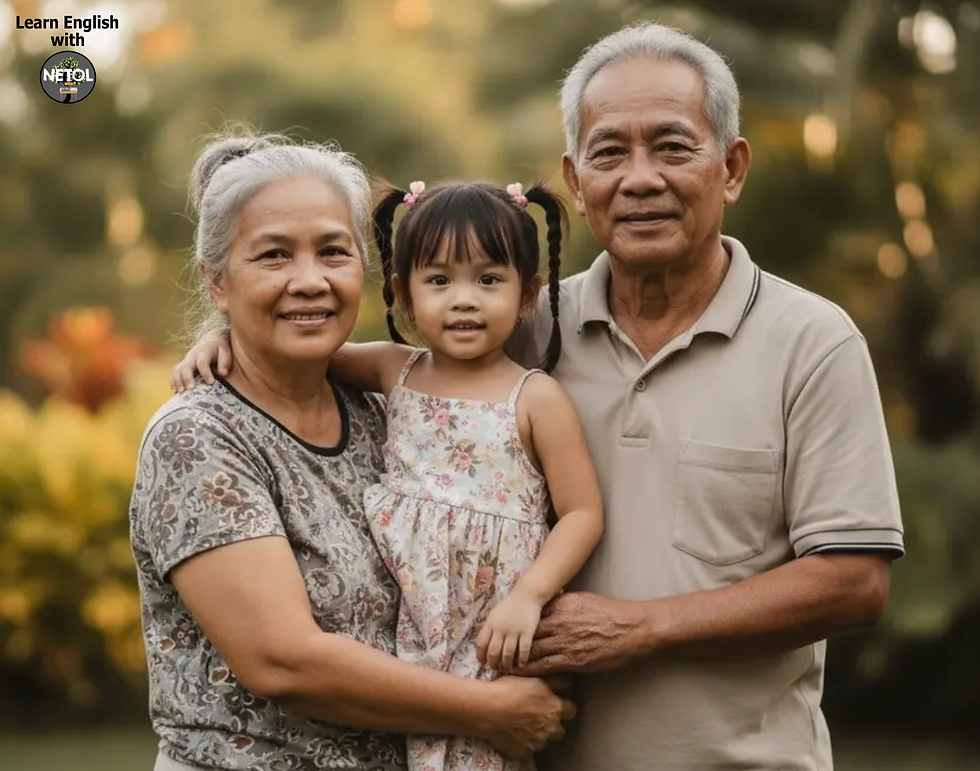
In this family, grandparents take care of grandchildren. They give love, wisdom, and support.
Adoptive Family

An adoptive family welcomes children through adoption. They give love and support to children not related by birth.
Foster Family

Foster families care for children who cannot live with their birth families. They offer safety and kindness until children can return home or find a new family.
Childless Family

A childless family is a couple without children. They focus on their relationship, hobbies, and sometimes pets.

Listening, Reading & Writing Practice
Narration Comprehending Activity
Instructions:
Get a pencil and paper.
Make a list from 1 to 7.
Listen and then read the 7 narrations.
Use the chart - Different Kinds Of Families, and decide which type of family matches each narration.
Practice your writing by writing the type of family next to each number on your paper.
Check your answers by clicking on the side arrows next to each narration.
Types Of Family
Narration Comprehension Activity

Narration #1
Narration #1: "I grew up with just one parent. My mom worked very hard to take care of my brother and me. She cooked for us, helped us with homework, and always made us feel safe. Even though she was busy, she never stopped supporting us. Our home felt full of love, even with only one parent." Which type of family does this narration describe?
ANSWER: Single-Parent Family

Narration #2
Narration #2: "I grew up in my grandparents’ house. They became my main caregivers because my parents worked in another city. My grandmother told me stories every night, and my grandfather taught me how to garden. They treated me with so much patience and kindness. Their home was always warm and peaceful." Which type of family does this narration describe?
ANSWER: Grandparent Family
Narration #3
Narration #3: “I grew up with both of my parents and my older sister. We ate dinner together every night and spent weekends taking small road trips. My parents supported us equally, and they always encouraged us to do our best in school. Our home life was simple but very stable.” Which type of family does this narration describe?
ANSWER: Nuclear Family
Narration #4
Narration #4: “I grew up in a family that chose me. My parents adopted me when I was very young, so I don’t remember living anywhere else. They always told me that I was special and that they were happy to welcome me into their lives. I have all the love and support I could ever need.” Which type of family does this narration describe?
ANSWER: Adoptive Family
Narration #5
Narration #5: “I grew up with two families becoming one. After my parents separated, my mom married someone new, and he had two children. We all moved into the same house and slowly learned how to share, understand each other, and live together. It wasn’t always easy, but it made our family bigger and stronger.” Which type of family does this narration describe?
ANSWER: Blended Family
Narration #6
Narration #6: “I grew up moving between different homes. Sometimes I stayed with one family for a few months, and other times for a whole year. The families that cared for me were kind and helped me feel safe while my life was changing. They made sure I had what I needed and that I never felt alone.” Which type of family does this narration describe?
ANSWER: Foster Family
Narration #7
Narration #7: “I grew up in a big, busy house. I lived with my parents, my siblings, my grandparents, my aunt, my uncle, and my cousins. There were always people talking, cooking, or playing games. We shared chores, celebrated every birthday together, and supported each other all the time. Life was lively, crowded, and full of love.” Which type of family does this narration describe?
ANSWER: Extended Family

Take Our Poll
Type Of Family I Grew Up In
Which type of family did you grow up in?
0%Nuclear Family
0%Extended Family
0%Single-Parent Family
0%Blended Family

Celebrating Family Day

Family Day is a holiday that is celebrated on the third Monday of February. Family Day was created so people could have a break during the long winter months. It gives Canadians time to focus on family, connection, and rest. Alberta was the first province to create it in 1990, and other provinces added it as a statutory holiday later. Many people spend the day with family, relax, and enjoy winter activities.

Statutory Holiday vs. Regular Holiday

A statutory holiday (also called a public holiday) is a holiday when most workers get a paid day off. Schools and many businesses are closed.
A regular holiday is a special day, but workers do not automatically get paid time off. Businesses may still be open.
Family Day is a statutory holiday in Ontario, Canada, but not all provinces or territories consider this holiday to be a statutory holiday. Family Day is considered to be a statutory holiday in these provinces:
Ontario
Alberta
British Columbia
Saskatchewan
New Brunswick

Celebrating Family Day &
Statutory Holiday Vs. Regular Holiday
Instructions:
Press the play buttons below.
Listen to the audio file.
Use the reading from above to follow along with the audio file.
Family Day &
Statutory Holiday Vs. Regular Holiday

Activities To Do On Family Day

*Before reading about the fun activities that people do on Family Day, look at each picture from above, and talk about what you see.
Family Day is a great time for families to spend time together and have fun. There are many different activities that families can do together, both indoors and outdoors. Here is. a list of fun activities families can enjoy on Family Day:,
Family Day Activity #1
Go Go‑Kart Racing

Description: Going go‑kart racing is when you drive small cars around an indoor or outdoor track. It is fast, exciting, and fun for older kids.
Example: A family signs up for a race, puts on helmets, and drives their go‑karts around the track to see who can finish first.
Family Day Activity #2
Play Laser Tag

Description: Playing laser tag is when you wear a vest and use a laser toy to tag other players with light. It is active, exciting, and fun for people who like running and hiding.
Example: A family splits into two teams and runs through the laser tag arena, trying to tag each other while laughing and hiding behind obstacles.
Family Day Activity #3
Do An Escape Room Challenge

Description: Doing an escape room challenge is when you go into a themed room and try to solve simple puzzles. It is a good activity for people who like working together.
Example: A family works together in a jungle‑themed escape room to find clues, unlock a treasure chest, and solve the final puzzle before time runs out.
Family Day Activity #4
Jump At A Trampoline Park

Description: Jumping at a trampoline park is when you bounce on big trampolines and foam pits. It is active, energetic, and fun for people who like moving around.
Example: A family jumps on the trampolines, plays a short game of dodgeball, and then takes turns flipping into the foam pit.
Family Day Activity #5
Go Snow Tubing

Description: Going snow tubing is when you sit in a large tube and slide down a snowy hill. It feels fast, smooth, and exciting, especially in winter.
Example: A family rides the magic carpet to the top of the snowy hill, sits in their tubes, and slides down together while cheering.
Family Day Activity #6
Play Video Games

Description: Playing video games is when you use a TV, computer, or console to play digital games. It is relaxing, entertaining, and easy to enjoy indoors.
Example: A family sits on the couch, chooses a racing game, and plays a friendly tournament to see who can get the fastest time.
Family Day Activity #7
Play In An Arcade Game Room

Description: Playing in an arcade game room is when you try different games like air hockey, racing games, or basketball toss. It is bright, loud, and fun for people of all ages.
Example: A family walks around the arcade, plays air hockey, collects tickets, and chooses a small prize at the end.
Family Day Activity #8
Go Indoor Rock Climbing

Description: Going indoor rock climbing is when you climb walls with colourful holds while using safety gear. It is active, challenging, and good exercise.
Example: A family puts on climbing gear, takes turns climbing an easy wall, and cheers when someone reaches the top.
Family Day Activity #9
Watch A Movie At A Theatre

Description: Watching a movie at a theatre is when you sit in a large room and watch a film on a big screen. It is calm, enjoyable, and a good way to relax.
Example: A family buys popcorn, chooses seats in the middle row, and watches a new animated movie together on the big screen.
Family Day Activity #10
Go Bowling

Description: Going bowling is when you roll a heavy ball to knock down pins at the end of a long lane. It is simple, social, and fun for beginners.
Example: A family takes turns rolling the ball, uses bumpers for younger kids, and celebrates when someone gets a strike.
Family Day Activity #11
Play Indoor Mini Golf

Description: Playing indoor mini golf is when you hit a small ball around a themed course with obstacles. It is playful, colourful, and easy for people of all ages.
Example: A family moves through a glow‑in‑the‑dark mini golf course, tries tricky holes, and laughs when the ball bounces off an obstacle.
Family Day Activity #12
Paint Pottery

Description: Painting pottery is when you choose a ceramic piece and decorate it with paint. It is calm, creative, and a nice way to make a special item.
Example: A family chooses mugs, plates and bowls, sits at a table, and paints colourful designs before leaving their items to be glazed.
Family Day Activity #13
Go Swimming At A Swim Complex

Description: Going swimming at a swim complex is when you enjoy pools, slides, or splash areas. It is refreshing, active, and fun for people who like the water.
Example: A family swims in the leisure pool, goes down the waterslide, and plays a simple game of catch in the shallow area.
Family Day Activity #14
Do Bedazzling Crafts

Description: Doing a bedazzling craft is when you decorate items with shiny gems and stickers. It is creative, simple, and fun for people who like art.
Example: A family sits at a craft table and uses shiny gems to decorate T‑shirts, making fun designs together.
Family Day Activity #15
Visit A Butterfly Conservatory

Description: Visiting a butterfly conservatory is when you walk through warm gardens with butterflies flying around you. It is peaceful, beautiful, and interesting to see up close.
Example: A family walks slowly through the warm garden, looks at butterflies landing on flowers, and takes photos of the colourful sights.
Family Day Activity #16
Play Board Games

Description: Playing board games is when you sit at a table and play games that use cards, dice, or a game board. It is social, relaxing, and easy to enjoy indoors.
Example: A family sits at the kitchen table and plays a board game like Uno or Snakes and Ladders while enjoying snacks.
Family Day Activity #17
Sing Karaoke

Description: Singing karaoke is when you choose a song and sing along to the music with a microphone. It is entertaining, silly, and fun for people who like music.
Example: A family picks favourite songs, sings into the microphone, and claps for each other after every performance.
Family Day Activity #18
Have A Family Paint Night

Description: Having a family paint night is when everyone follows simple steps to paint a picture on canvas. It is creative, calm, and a nice way to spend time together.
Example: A family follows a simple online painting tutorial and creates colourful sunset pictures on canvas while chatting and relaxing.

Reading & Writing Practice
Family Day Activities Matching Exercise
Instructions:
Get a pencil and paper.
Make a list from 1 to 10.
Read the 10 narrated descriptions.
Use the chart - Popular Family Day Activities, and decide which Family Day narration matches which activity.
Practice your writing by writing the name of the activity next to each number on your paper.
Check your answers by clicking on the side arrows next to each situation.
Family Day Activities Matching Exercise

Situation #1: "My name is Samuel. On Family Day, I wanted to relax with my wife and daughter. So, we went to a place where we shared snacks, sat in comfortable seats, and watched a story come alive on a very big screen." Which activity does this situation describe?
ANSWER: Watch a movie at a theatre
Situation #2: "My name is Ren. This Family Day, my family and I went to a place where we walked through a glowing course, used a small club, and tried to hit a colourful ball past different obstacles." Which activity does this situation describe?
ANSWER: Play indoor mini golf
Situation #3: "My name is Selama. This Family Day, I wanted to do something that is calm and beautiful with my family. So I took them to a place where we walked slowly, took photos, and watched colourful wings fly past us in warm, tropical air." Which activity does this situation describe?
ANSWER: Visit a butterfly conservatory
Situation #4: "My name is Carlos. This Family Day, my family and I turned on our game console, chose a fun game, and played together to see who would win the round." Which activity does this situation describe?
ANSWER: Play video games
Situation #5: "I’m Anika. This Family Day, we wanted to go out and do something simple and fun. We went to a place where we rolled a heavy ball down a long lane and tried to knock down as many pins as we could." Which activity does this situation describe?
ANSWER: Go bowling
Situation #6: "My name is Maria. On Family Day, my family and I stayed home and played something fun at the table. We picked a game, took turns, and tried to beat each other with cards, dice, or strategy. We laughed so much we almost forgot who won." Which activity does this situation describe?
ANSWER: Play board games
Situation #7: "I’m Mia. This Family Day, I wanted to do something relaxing and creative with my family. I didn’t want to rush. I sat down, chose a ceramic piece, and decorated it with bright colours and simple designs." Which activity does this situation describe?
ANSWER: Paint pottery
Situation #8: "My name is Daniel. This Family Day, my family and I wanted to do something active. We enjoyed climbing and trying new challenges. We strapped on special gear, followed the coloured paths, and cheered when someone reached the top." Which activity does this situation describe?
ANSWER: Go indoor rock climbing
Situation #9: " My name is Lauren. This Family Day, I wanted to do something active indoors. So I took my husband and my sons to a place where we bounced high, jumped into foam pits, and tried small tricks. It was a fun way to burn energy and have fun together." Which activity does this situation describe?
ANSWER: Jump at a trampoline park
Situation #10: "My name is Noah. This Family Day, I took my family somewhere refreshing where we floated in water, and practiced our swimming in the shallow area." Which activity does this situation describe?
ANSWER: Go swimming at a swim complex
Take Our Poll
Family Day Activity That You Like The Most
Which Family Day activity do you like the most?
0%Go Go-Kart Racing
0%Go Bowling
0%Play Laser Tag
0%Play Indoor Mini Golf

What Are Personal Qualities?

Personal qualities are the behaviours, attitudes, and character traits that show how a person thinks, feels, and acts in everyday life. These qualities help people build strong relationships, communicate well, and solve problems in positive ways. Personal qualities also show what kind of person someone is on the inside—whether they are kind, patient, honest, or hard‑working. Everyone has different qualities, but many of them can be learned and improved with practice. When family members show good personal qualities, they help create a caring and respectful home where everyone feels safe and supported. Understanding personal qualities also helps us get along better with people at school, at work, and in the community.

Important Personal Qualities

1. Kind
Explanation: Being friendly and caring toward others.
Example: Sofia is always kind, especially when she helps younger students feel welcome.
2. Patient
Explanation: Staying calm when things take time or do not go as planned.
Example: Liam stayed patient while his little brother learned how to tie his shoes.
3. Honest
Explanation: Telling the truth and being sincere.
Example: Aisha was honest when she told the teacher she forgot her homework.
4. Responsible
Explanation: Taking care of your duties and doing what you should do.
Example: Ethan is very responsible and never forgets to feed the family dog.
5. Respect
Explanation: Treating people politely and valuing their feelings.
Example: Bella is always respectful and listens carefully when others are speaking.
6. Cooperative
Explanation: Working well with others to reach a shared goal.
Example: Lilly was cooperative during the group project and helped everyone stay organized.
7. Empathetic
Explanation: Understanding how someone else feels.
Example: Olivia was empathetic when she comforted her friend who felt upset.
8. Confident
Explanation: Believing in yourself and your abilities.
Example: Daniel felt confident while giving his class presentation.
9. Creative
Explanation: Thinking of new and interesting ideas.
Example: Chloe is very creative and loves designing her own art projects.
10. Courageous
Explanation: Being brave when facing challenges or fears.
Example: Aiden was courageous when he tried skating for the first time.
11. Generous
Explanation: Willingness to share time, things, or help with others.
Example: Hannah is generous and often shares her snacks with friends.
12. Loyal
Explanation: Staying supportive and faithful to people you care about.
Example: Marcus is a loyal friend who always stands by the people he cares about.
13. Self‑Controlled
Explanation: Managing your emotions, actions, and choices.
Example: Jasmine stayed self‑controlled even when she felt annoyed.
14. Fair
Explanation: Treating everyone equally and making just decisions.
Example: Caleb was fair and made sure everyone got a turn in the game.
15. Grateful
Explanation: Being thankful for the good things in your life.
Example: Sienna felt grateful when her parents helped her with her project.
16. Reliable
Explanation: Being someone others can trust and depend on.
Example: Thomas is very reliable and always keeps his promises.
17. Perseverant
Explanation: Continuing to try even when something is difficult.
Example: Emily stayed perseverant and kept practising the piano until she improved.
18. Positive
Explanation: Having a hopeful and cheerful attitude.
Example: Jayden is positive and always looks on the bright side of things.
19. Communicative
Explanation: Sharing ideas clearly and listening to others.
Example: Paula is very communicative and explains her ideas clearly during group work.
20. Problem‑Solver
Explanation: Finding solutions when challenges appear.
Example: Lucas is good at problem‑solving and quickly finds a solution when something breaks.
Important Personal Qualities
Instructions:
Press the play buttons below.
Listen to the audio file.
Use the reading from above to follow along with the audio file.
Important Personal Qualities

Family Members' Personal Qualities

In our families, each person has special personal qualities that make them important to us. Parents are often kind and responsible because they take care of the family and help us feel safe. Siblings can be patient and cooperative when we play or work together. Our grandparents are usually very caring and grateful, and they enjoy spending time with us. Other family members, like cousins, aunts, and uncles, can be creative, positive, or honest, which makes family gatherings fun and comfortable. These qualities help us understand each other better and make our family strong and supportive.

Reading & Writing Practice
Fill In The Chart Activity
Instructions:
Get a pencil, ruler, and paper.
Copy the chart from below.
Write 2 personal qualities for each family member that you have.
Check your answers by clicking on the side arrows.
***You can download the chart, print it and fill it out by clicking on the link below.
Fill In The Chart Activity

Here is a chart that you can use: Write 2 personal qualities for each family member:
Family Member | Personal Quality 1 | Personal Quality 2 |
Parent | ||
Sibling | ||
Daughter/Son | ||
Aunt/Uncle | ||
Cousin | ||
Grandparent | ||
Great Grandparent |
← Click on the arrow on the left to see possible answers.
Family Member | Personal Quality 1 | Personal Quality 2 |
Parent | responsible | reliable |
Sibling | helpful | cooperative |
Daughter/Son | creative | positive |
Aunt/Uncle | generous | communicative |
Cousin | playful | kind |
Grandparent | thoughtful | patient |
Great Grandparent | wise | loyal |

My Very Special Family Member

Everyone has a very special family member who makes their life better. A special family member is someone who shows love, support, and kindness every day. This family member can be a parent, a sibling, a grandparent, or anyone in the family who brings joy and comfort. This person helps us feel loved and reminds us that family is important.

Speaking Presentation Activity
Talk About Your Special Person
& Their Personal Qualities
Instructions:
Select a special person that you want to talk about.
Listen to the example presentation from below.
Get a pencil, ruler, and paper and write about your special person using these questions:
Who is the person that you chose?
How is this person related to you?
Where does this person live?
Why did you choose this person?
What are some personal qualities that this person has that make this person so special to you?
When was the last time that you saw this person?
Practice your speaking by practicing saying what you wrote out loud.
Memorize your presentation.
Record yourself saying the presentation out loud.
***You can record your presentation, send it to Learn English with NETOL and an instructor will listen to your presentation and give you feedback.
Speaking Presentation Example
My Special Person & Their Personal Qualities

↓

Concluding Thoughts

Families come in many forms, and every family member has an important role. Learning about different families helps us understand and appreciate the love and support they bring. Special days like Family Day remind us to spend time together and celebrate the people who help us grow into kind and caring individuals.

Test Your Knowledge By Taking Our Quiz
Instructions:
Read the 10 multiple-choice questions from below.
Answer each question.
Click the Submit button when you are done.
Click the View Score button to see how you did on the quiz.


Click below for a reading without the accompanying activities:


Continue teaching this lesson with this resource:


Written by: Nicole WT & Bella T
Copyright © Learn English with NETOL. All rights reserved.


Very good and interactive lesson. I am a teacher and I was looking for a lesson that included different types of family members. This lesson helped my students learn about all of the different types of family members. Great find!