


Lesson & Activities - Observing Remembrance Day In Canada
Updated: May 3


✦ This lesson includes these sections:
✦ Click on each section from above to see it ↑
✦ Click on each title box from below to get back here ↓

Observing Remembrance Day In Canada


Speaking Activity
Conversation Questions
Instructions:
Listen to and read the conversation questions.
Practice your speaking by answering each question out loud.
See some possible answers to the conversation questions by clicking the side arrows next to each question.
Conversation Questions
1. Do you think Remembrance Day is important? Why?
Yes. It helps us remember and be thankful for peace.
2. Why do we wear a poppy?
We wear a poppy to show respect. It helps us remember those who died.
3. Do you know any veterans in your family or community?
Yes, my grandfather served. He told us stories.
4. Why do people give money for poppies?
The money helps veterans and their families. It supports care services.
5. How do schools observe Remembrance Day?
Schools may have assemblies. Students may read poems and have a moment of silence on Remembrance Day.

Writing Activity
Pre-Reading Vocabulary
Instructions:
Get a pencil and paper.
Copy the words from below.
Look up the definitions of the words online.
Get to know the definitions of each word
Important Words - Observing Remembrance Day
observing
remembrance
armed forces
cenotaph
honour
ceremony
bugle
poppy
poem
war
wounded
sacrifice
veterans
served

Reading Activity
Observing Remembrance Day In Canada
Instructions:
Read the following passage.
Thereafter, listen to the audio file.
Note: Reading out loud when learning a new language is important because it helps you practice your pronunciation. When you speak the words, you can hear how they sound, and this will improve your speaking skills.

Observing Remembrance Day In Canada

Remembrance Day is observed on November 11 each year. It marks the end of the First World War, which was on November 11, at 11 a.m. in 1918, and it honours the men and women who served in the armed forces. On this day, Canadians stop at 11:00 a.m. for a two‑minute silence. People wear poppies, go to ceremonies at cenotaphs, and remember those who died and those who were wounded.
Who Gets The Day Off On Remembrance Day

Remembrance Day is not a statutory holiday for most workers in Canada. Whether someone gets the day off or not depends on where they live and who their employer is in Canada. Some federal employees and some provincial public servants have the day off on Remembrance Day. Many businesses and schools stay open.

How Canadians Observe Remembrance Day

On November 11 at 11:00 a.m., many people stop what they are doing to remember. Towns and cities hold ceremonies at cenotaphs and memorials. A bugler plays The Last Post. People lay wreaths and place flowers. There is a two-minute silence to honour the fallen. Veterans, family members, community leaders, and many citizens attend these services to show their respect.

Video: The Last Post
Observing Remembrance Day At School In Canada

Schools often hold classroom activities and assemblies. Students may read poems, make poppies, sing songs, learn about the history of the wars, or watch videos about Remembrance Day. These activities help young people understand why this day holds such significance in Canada.
“Lest We Forget”

Remembrance Day honours people who served in the armed forces and remembers those who died or were wounded. The phrase “Lest we forget” is a reminder not to forget their sacrifice. It asks us to keep their memory alive and to learn from the past.

Wearing A Poppy On Remembrance Day

The poppy is a red flower symbol. It grew on battlefields long ago. Today, we wear a poppy on the left side of our body, near the heart, to show respect and honour those who have served. People pay for the poppies, and the money from the Poppy Fund in Canada helps Canadian veterans and their families.
In Flanders Fields And John McCrae

There is a famous poem that is called “In Flanders Fields”. It was written by Lieutenant Colonel John McCrae in 1915, and it is closely linked to Remembrance Day and wearing a poppy on this special day.
John McCrae served as a doctor during the war. He wrote the poem “In Flanders Fields” after he saw poppies grow between the crosses on the soldiers’ graves, and after he lost a friend in battle. The poem connects the poppy flower to the soldiers who died. The poem is a mix of sadness with a call to keep the memory of the soldiers who died.
Video: In Flanders Fields by John McCrae
Concluding Thoughts About Remembrance Day
In conclusion, Remembrance Day is a day for Canadians to honour the brave people who served and those who died or were wounded in the war. We show respect by wearing a poppy, and we attend ceremonies at cenotaphs. It is a day that teaches each of us to remember and be thankful for our peace and freedom in Canada.

Listening Activity
Observing Remembrance Day In Canada
Instructions:
Press the play buttons below.
Listen to the audio file.
Use the reading from above to follow along with the audio file.
Observing Remembrance Day In Canada
Video: Remembrance Day Symbols

Listening, Reading & Writing Activities - Matching Exercise
Instructions:
Get a pencil and paper.
Make a list from 1 to 10.
Listen and read the information in the video.
Read each symbol description.
Use the Remembrance Day Symbols Chart from below to decide which symbol description goes with each symbol and write your answers on your paper.
Check your answers by clicking on the side arrows next to each Remembrance Day symbol.
Symbols Of Remembrance Day
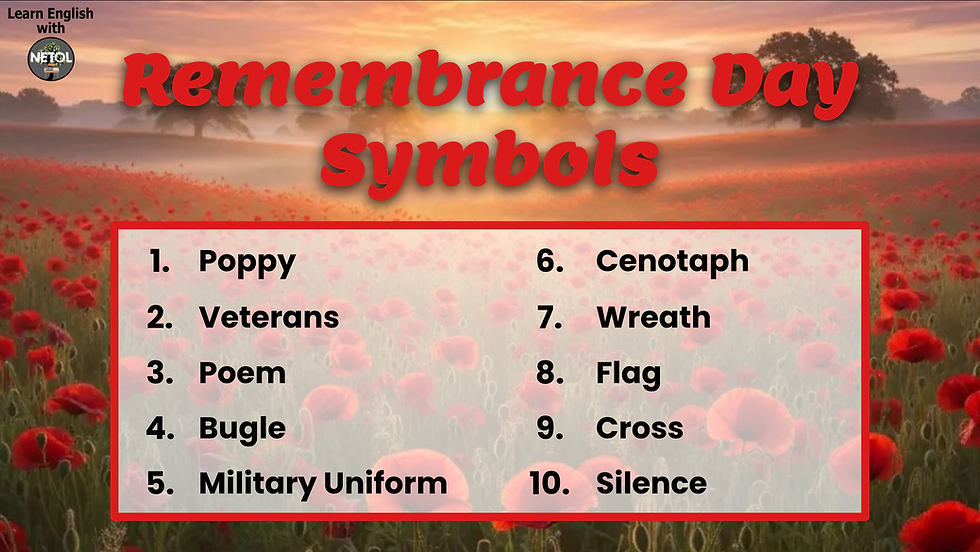
1. Remembrance Day Symbol Description: This is a circle of flowers. People lay this at memorials. Which Remembrance Day symbol does this description describe?
Wreath
2. Remembrance Day Symbol Description: This small brass instrument plays at ceremonies. It often plays The Last Post. Which Remembrance Day symbol does this description describe?
Bugle
3. Remembrance Day Symbol Description: This red flower is a symbol. People wear it to honour soldiers. Which Remembrance Day symbol does this description describe?
Poppy
4. Remembrance Day Symbol Description: This shows a country. People lower it to half-mast to show respect. Which Remembrance Day symbol does this description describe?
Flag
5. Remembrance Day Symbol Description: These are the clothes soldiers wear. Veterans sometimes wear them at ceremonies. Which Remembrance Day symbol does this description describe?
Military Uniforms
6. Remembrance Day Symbol Description: These are people who served in the armed forces. We thank them for their service. Which Remembrance Day symbol does this description describe?
Veterans
7. Remembrance Day Symbol Description: People stop and stay quiet for two minutes. The quiet shows respect. Which Remembrance Day symbol does this description describe?
Silence
8. Remembrance Day Symbol Description: This is a short text with feelings. People read poems at services. Which Remembrance Day symbol does this description describe?
Poem
9. Remembrance Day Symbol Description: A simple grave marker. It shows where a soldier rests. Which Remembrance Day symbol does this description describe?
Cross
10. Remembrance Day Symbol Description: A public war memorial in a town. People go there to remember. Which Remembrance Day symbol does this description describe?
Cenotaph

Take Our Poll
Remembrance Day
Do you know anyone who has served in the Canadian Armed Forces during the War?
0%Yes!
0%No!
0%I am not sure.

Test Your Knowledge By Taking Our Quiz
Instructions:
Read the 10 multiple-choice questions from below.
Answer each question.
Click the Submit button when you are done.
Click the View Score button to see how you did on the quiz.


Click below for a reading without the accompanying activities:


Click on the following resources.
Each resource includes a lesson with printable and digital activities:

Written by: Nicole WT
Copyright © Learn English with NETOL. All rights reserved.


Comments